
Industries
Power Plant Cleaning for Plant Offices, Service Centers and Shops
Loop Office Cleaning cleans the staffed buildings at generating stations and utility sites: administration offices, control-building break rooms and restrooms, locker rooms, shops, warehouses and utility service centers, on a route the host’s safety rules set.
Clean workplaces at a generating station
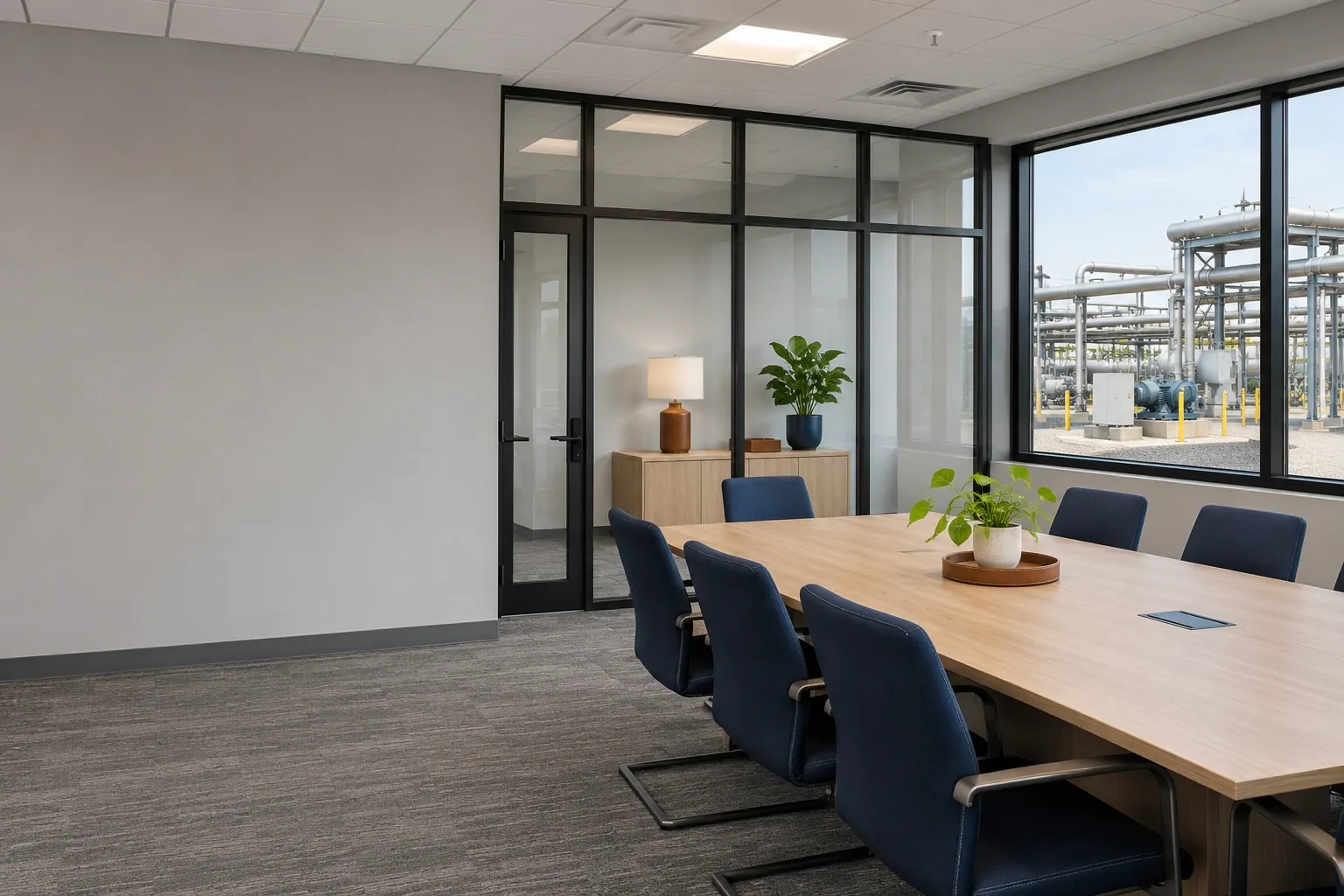
Every power plant has a staff side: the front office, the control building’s kitchen and restrooms, locker rooms, training rooms, shops and the warehouse. Utility service centers and administrative buildings add more desks and meeting rooms. Loop cleans those spaces for plant facility managers, EHS leads and service center managers, and the host’s own rules decide which rooms are on the route and when.
Offices and staff rooms follow our office cleaning plan, and shops and warehouse floors are handled the way our industrial cleaning crews work in plants, so soil from the yard stays out of the corridors and the break room.
Plant buildings and what crews clean
| Building or room | Cleaning tasks | Decided by the host |
|---|---|---|
| Administration offices and meeting rooms | Desks, glass, floors, trash, kitchenettes | Visit times and visitor sign-in |
| Control building break rooms and restrooms | Counters, appliances, fixtures, floors, supplies | Which doors crews may use and escort needs |
| Locker rooms and showers | Benches, showers, sinks, floors, waste | Shift-change times |
| Shops and warehouses | Sweeping, scrubbing, cleared benches, high dusting from lifts | Tagged equipment, posted spaces and approved products |
| Utility service centers | Offices, dispatch rooms, training rooms, restrooms | Hours the building is staffed |
Paper, liners and soap can come from Loop’s janitorial supplies service, and a day porter can keep restrooms and break rooms stocked across a long shift.
Information the host shares before day one
OSHA’s power generation standard, 29 CFR 1910.269, uses the terms host employer for the company that runs the installation and contract employer for the firm working there under contract. Where it applies, the host must tell the contractor about the installation’s characteristics and known hazards before work begins, the contractor passes that on to its own workers and reports any unanticipated hazard it finds within 2 working days, and the two coordinate their work rules.
Whether a given office or service building falls under that standard is the host’s call. Either way, Loop asks for the site orientation, the PPE list, the sign-in steps and the approved products before the first visit, and every crew member works to them.
Energized rooms are the host’s decision
Under 1910.269, rooms holding electric supply equipment are enclosed or guarded, carry warning signs at the entrances, and stay locked when not watched; unqualified people may not enter them while the equipment is energized. Only qualified workers may work near exposed energized parts. In California, Title 8’s High-Voltage Electrical Safety Orders treat more than 600 volts as high voltage and limit work on energized high-voltage equipment to qualified electrical workers.
So the route is drawn around those rooms. Switchgear rooms, energized yards and similar spaces are entered only under the host’s rules, and a cleaning visit that touches one is scheduled with the host’s own staff. Exterior work with poles or lifts follows Title 8’s minimum clearances from overhead lines.
Tags, locks and posted spaces
Cleaning counts as servicing under OSHA’s lockout/tagout standard, 29 CFR 1910.147. Workers who are not authorized to apply locks are told about the procedure and must never try to restart locked-out or tagged-out equipment, and a tag is never removed without authorization. When outside contractors are on site, the host and the contractor tell each other about their lockout procedures. For machinery in California, Title 8 section 3314 calls for equipment to be stopped and de-energized or disengaged before cleaning, with signs or tags on the controls.
Confined spaces have their own rule. Under 29 CFR 1910.146 a permit space is posted with a danger sign, and the host tells contractors where permit spaces are and what precautions it takes. Our crews clean around tagged equipment as the host directs and leave posted spaces alone.
Escorts inside a physical security perimeter
Some utility buildings sit inside a perimeter governed by NERC’s CIP-006 standard, which binds the registered utility, not its contractors. The utility’s plan allows unescorted access only to authorized people, keeps visitors under continuous escort, and logs each visitor’s name, the date and time of first entry and last exit, and the person responsible for them, with logs kept at least ninety calendar days. CIP-006-7, adopted by NERC’s Board in May 2024, keeps those escort and logging rules.
Escorted cleaning is booked as a fixed window with a named escort, so the host’s staff spend as little time as possible watching the work.
California’s generation mix
Per the California Energy Commission’s 2025 Total System Electric Generation page, in-state generation in 2025 was 205,698 GWh. The largest sources by share were natural gas (36.13%), solar (26.99%), large hydro (11.73%), nuclear (8.54%), wind (7.38%) and geothermal (5.30%). Owners of plants of 1 MW or more report their generation to the CEC, including cogeneration plants at refineries and university campuses.
By our estimate from the CEC’s capacity database (data as of June 16, 2026), natural gas plants made up about 43% of the state’s 2025 in-state installed capacity, and solar about 27%. Each of those plant types has offices, shops and staff rooms that need regular care.
Rules by state
California runs an OSHA-approved State Plan, with Cal/OSHA covering most private-sector workplaces. Nevada runs its own approved State Plan through Nevada OSHA, which has offices in Las Vegas and Reno and has adopted most federal OSHA standards by reference. Loop serves utility and plant workplaces from Sacramento, Stockton, Oakland, San Jose and Las Vegas, and the host’s rules decide the details at each site, as of November 2026.
Visits around shifts and outages
Control buildings are often staffed around the clock, so their kitchens and restrooms are cleaned between shift handovers. Planned outages bring extra people and extra soil, and the calendar can add visits before and after. Each Loop cleaner is background-checked; the company is bonded and insured with workers’ compensation in place, and a certificate of insurance goes to every client. Supervisors carry out quality inspections against the host’s room list.
Secured technical buildings follow the same site-rules approach on our data center cleaning and laboratory and cleanroom cleaning pages.
Ask for a power plant cleaning quote
Tell us the buildings, the staffed hours, the escort and orientation steps and any outage dates. A walkthrough with your facility or EHS lead sets the route and a written quote. Request a power plant cleaning quote.
A few useful answers
Common questions
What does Loop need from our safety team before starting?
The site orientation, known hazards, PPE list, sign-in steps, approved products and which doors and rooms are on the route.
Do your cleaners go into switchgear rooms or energized yards?
Those spaces are entered only under the host’s rules, and a visit that involves one is planned with the host’s own qualified staff.
What happens when a cleaner finds a lockout tag on shop equipment?
The tag and lock stay exactly as found. Crews clean around the equipment only as the host directs and report anything that looks wrong.
Can a utility service center share a plan with the plant office?
Yes. Each building gets its own room list and visit days on one schedule, with a supervisor checking both.
Can extra visits be booked around a planned outage?
Yes. Visits can be added before and after the outage window for break rooms, restrooms and locker rooms that see heavier use.
Services